This article is general information, not tax, legal or investment advice. Tax rules change and depend on your situation. Check the IRS’s current instructions or consult a qualified tax professional.
Many people who buy a little cryptocurrency expect the tax rules to be a footnote. They are not. The Internal Revenue Service has said for years that digital assets are taxable, and the agency has been adding reporting requirements that make transactions harder to overlook. Understanding the basic framework helps explain what gets reported and why record-keeping matters.
How the IRS classifies crypto
For federal tax purposes, digital assets are treated as property, not as currency. The IRS first set out this approach in guidance issued in 2014, and it repeats it on its digital assets page, which defines a digital asset as a digital representation of value recorded on a cryptographically secured distributed ledger or similar technology. The definition covers convertible virtual currencies such as Bitcoin, stablecoins and non-fungible tokens.
Treating crypto as property means the general rules for property apply. When you dispose of it, you compare what you received with your basis, which is generally what you paid in U.S. dollars, including certain costs. The difference is a capital gain or a capital loss.
What counts as a taxable event?
The IRS lists a range of situations. Common ones include:
- Selling crypto for dollars.
- Exchanging one crypto asset for another. A trade is a disposal of the first asset, even though no dollars change hands.
- Using crypto to buy goods or services. Spending it is treated as a sale at its market value at the time.
- Receiving crypto as payment for work, or as a reward for activities such as mining or staking. That is generally income, measured at the fair market value when it is received.
- Receiving new tokens in an airdrop tied to a hard fork, which the IRS treats as income.
Some actions are generally not taxable on their own: buying crypto with dollars and holding it, and moving assets between wallets you control. The IRS notes that paying a transaction fee in crypto can count as a disposal, which is why even a transfer can leave a small taxable trace.
How gains are taxed
Whether a gain is short term or long term depends on the holding period. Assets held one year or less produce short-term gains, taxed at ordinary income rates. Assets held for more than a year produce long-term gains, which are taxed at lower rates. Capital losses can offset capital gains, and under general rules a limited amount of net losses can be deducted against other income each year, with the remainder carried forward.
Income from mining, staking or being paid in crypto is reported as income, not as a capital gain, and the value at that time becomes your basis for later sales. Records of amounts, dates and values are therefore essential.
What appears on the tax return
Federal returns ask a yes-or-no question about digital assets. It appears near the top of Form 1040 and asks whether, at any time during the tax year, you received a digital asset as a reward, award or payment for property or services, or sold, exchanged or otherwise disposed of one. According to the IRS, you can answer no if you only held assets, bought them with dollars or moved them between your own wallets. You must answer the question accurately whether or not a transaction produced a gain.
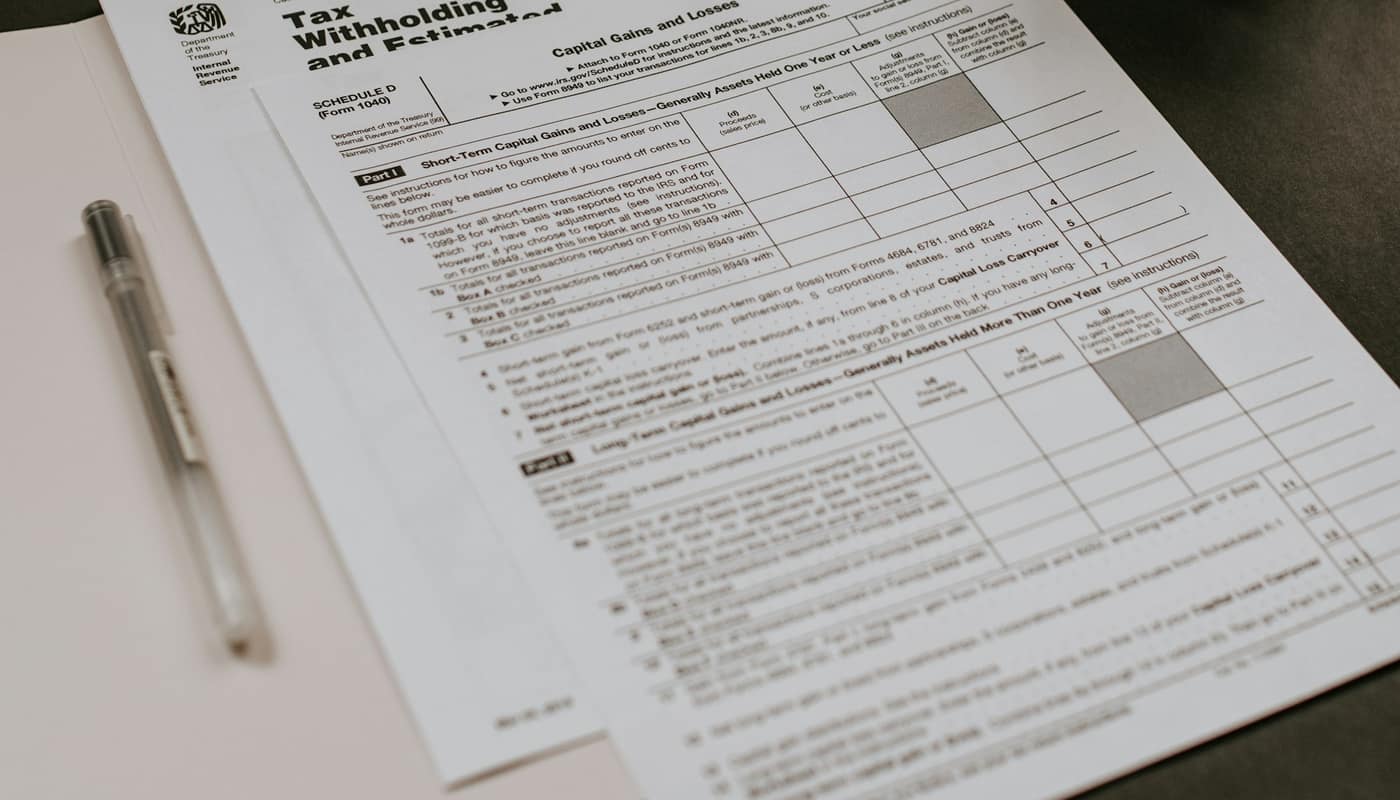
Sales and exchanges are generally reported on Form 8949 and summarized on Schedule D, and income from mining and staking goes on Schedule 1 or Schedule C, depending on whether it is a business activity.
What is Form 1099-DA?
The newest piece of the framework is broker reporting. Under Treasury regulations finalized in 2024, brokers that handle digital asset sales must report them to the IRS and to customers on Form 1099-DA. According to the IRS:
- Brokers report gross proceeds for transactions on or after January 1, 2025.
- Brokers report cost basis for certain transactions on or after January 1, 2026.
- For 2025 transactions, the IRS said it will not penalize brokers that make a good-faith effort to comply.
- The rules do not cover decentralized or non-custodial services that never take possession of the assets.
This matters because the form tells the IRS what you sold on an exchange. It does not replace your own duty to report. Broker statements can be incomplete or may not capture activity across several platforms, and a self-custody wallet that trades through a decentralized service may produce no form at all.
Records worth keeping
- A log of each transaction with the date, the asset, the amount, the value in dollars and what it was for.
- Purchase records that show your basis, including fees.
- Exchange statements and downloads, saved before platforms change or close.
- Records of income received, such as rewards or payments, with values at the time.
- Wallet addresses you control, to show transfers were between your own accounts.
Recent IRS guidance changed how basis can be tracked across different wallets and accounts, so check the current instructions or ask a tax professional how to apply them. Software and tax professionals can import exchange data, but the filer remains responsible for accuracy.
Common mistakes
People forget that trading one coin for another is taxable. They overlook small purchases made with crypto. They fail to record income from staking or airdrops, or they mix up the basis. Another is assuming that holding crypto in a wallet outside the United States or on a platform that issues no form exempts it from reporting. It does not.
How assets are held also affects the paper trail. Exchanges that keep your assets produce records, while the choices involved in self-custody put more of the record-keeping on you, a trade-off described in exchange custody versus self-custody. For background on what you might be reporting, how Bitcoin works explains the asset itself.
When in doubt, the IRS’s digital assets page, its form instructions and a qualified tax preparer are the places to look. Nothing here is a substitute for them.
Sources: Internal Revenue Service; U.S. Department of the Treasury; IRS Notice 2014-21; Form 1099-DA instructions